
 KOREAN
 ENGLISH
T. +82.42.933.9870
Copyright © UNIOTECH Co., Ltd.
All Rights reverved.
Copyright © UNIOTECH Co., Ltd.
All Rights reverved.
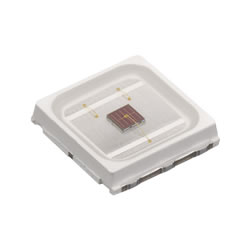
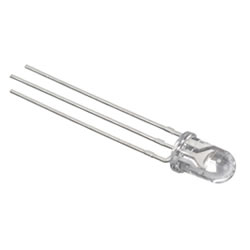
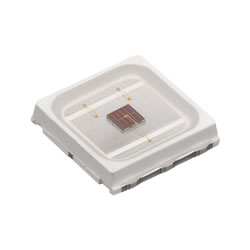
| Product # | Discontinued? | Datasheet | Wavelength (nm) | Package Type | Package Size | Forward IF(mA) Current | Total Radiated Power Po(mW) | Viewing HalfAngleΘ1/2 (degree) |
|---|---|---|---|---|---|---|---|---|
| SMT735/780/810 | No |  | 735/780/810 | SMD | 3.5mm x 2.8mm | - | - | - |
| SMT735/810/850 | No | | 735/810/850 | SMD | 3.5mm x 2.8mm | - | - | - |
| SMT735D/850D | No | | 735/850 | SMD | 3.5mm x 2.8mm | - | - | - |
Tech-LED’s Bi-Color and Multi-Color LED category includes LEDs that emit two or more colors from a single package. These devices integrate multiple LED chips of different wavelengths, allowing one component to produce various colors or a combined output (for example, blending colors for an intermediate hue or broad spectrum). Our bi-color LEDs typically have two chips (often with separate leads or a common cathode/anode configuration), while multi-color LEDs may have three or more chips (such as RGB LEDs or even 4-in-1 and 5-in-1 packages). We engineer these LEDs so that the different dies are closely co-located, ensuring that light originates from virtually the same point for good color mixing. The multi-color lineup spans from simple two-color indicator LEDs to advanced multi-wavelength emitters for specialized uses (like combined IR+Visible for biometric sensing). Each device in this family exemplifies versatility – one LED, multiple functions.
Status and Indicator Lighting: One of the most common uses of bi-color LEDs is status indication. Think of a single LED on a device that glows green during normal operation and red for an error – that’s a bi-color LED at work. Tech-LED supplies these to numerous equipment manufacturers. Our red/green and red/blue through-hole LEDs are found on everything from power supplies to telecom hardware, indicating statuses clearly with one indicator window. The benefit is a simpler, cleaner interface (one LED, two colors) and sometimes reduced drilling/board holes on a PCB. Similarly, in automotive dashboards, bi-color or even tri-color LEDs create multi-function telltales (like a single LED icon that can change color depending on severity of a condition).
Multi-Color illumination and displays: RGB LEDs, in particular, enable full-color displays and lighting that can change color. Our high-brightness RGB SMD LEDs are used in LED signage, message boards, and decorative lighting where millions of colors are needed. By PWM-controlling each die, customers can generate any hue or perform color-changing effects. We also service the stage lighting and entertainment industry with multi-color LEDs (and modules like small RGBW clusters) that serve as building blocks for LED stage lights or pixel mapping LED curtains. Having tightly grouped multi-chips ensures the light is mixed at the source, producing saturated colors or tunable white light for lighting designers.
Medical sensing (Pulse Oximetry & Vital Signs): As mentioned, a critical application for dual-color LEDs is in pulse oximeters and heart rate sensors. These devices typically use a red (~660 nm) and an IR (~940 nm) LED that shine through a fingertip or earlobe, and a photodiode reads the transmitted light to determine oxygen saturation and pulse. Tech-LED’s bi-color red/IR LEDs are used in medical OEM finger clips and even in wearables for this purpose. By integrating the two wavelengths in one package, we ensure they are co-linear – which improves measurement accuracy and simplifies the opto-mechanical design. We also produce green/IR combos for newer wearable heart-rate monitors (some wearables use green for daytime use and IR for night or low-power mode). The eye-tracking and facial recognition systems can also benefit: some designs use a visible LED (for user-facing feedback) and an IR LED (for camera tracking) combined, for example in an AR/VR headset – a single component can provide a visible indicator light as well as an IR illuminator for the eye-tracking camera.
Remote controls and IR communication: A less obvious multi-“color” application is pairing IR LEDs of different wavelengths for improved IR communication. For instance, an IR remote or beacon might use a dual IR LED (850 nm + 940 nm) to take advantage of the higher power of 850 nm and the complete invisibility of 940 nm. Together, they can create a broader IR spectrum that is easier for a receiver to pick up (some sensors respond better at 850, others at 940). Tech-LED has provided custom dual-IR emitters for remote controls that need extended range and reliability under various lighting conditions.
Horticulture and Agriculture: Multicolor LEDs (particularly red + blue, and red + far-red) are significant in smart farming. Plants respond strongly to certain wavelengths (blue ~450 nm for vegetative growth, red ~660 nm for flowering, far-red ~730 nm for phytochrome responses). Our dual-color plant growth LEDs combine, for example, 660 nm and 730 nm in one package. This allows very compact grow light designs where each LED outputs a mix optimized for plant development. Similarly, some of our customers use UV + white dual LEDs to give a mix of UV (to enhance plant color or pest resistance) and white light (for human visibility in the grow area) in greenhouse lighting.
Indicators with configurable color: Some devices let users or systems change the indicator color (for example, an LED ring on a smart speaker that can be any color). These often use our tri-color (RGB) LEDs underneath a light guide to create a smooth, uniformly colored ring. By combining three colors in one LED, it’s easier to calibrate and get uniform mixing than separate single-color LEDs spread out. We have high-consistency RGB LEDs for such uses, ensuring that from unit to unit the color coordinates match when driven equally.
In essence, wherever there’s a need for multiple colors from one point, Tech-LED’s bi-color and multi-color LEDs are the solution. They simplify design (fewer LEDs to place), save space, and often improve the functionality (color alignment, mixing, and matching) compared to discrete single-color LEDs. From user interface lights to complex biomedical sensors, these multi-color LEDs provide flexibility and functionality that single-color LEDs cannot – all in a neat, efficient package. Our expertise in combining chips means customers can request unusual pairings (say, a custom 4-wavelength LED that puts 470 nm, 560 nm, 660 nm, and 940 nm together for a specialized analyzer) and we can deliver a reliable component that meets those needs. This commitment to customization and performance is why leading product developers turn to Tech-LED for multi-color LED solutions.